Wednesday, February 7, 2024

"Show Don't Tell" Writing Exercises (Classwork 2/7)

 1A).


Jesse James strikes again. 


Nearly 100 years have passed since the infamous Jesse James and his brother Frank attempted to rob the First Fidelity Bank.


This morning, Jesse James, the great-great nephew of the legendary outlaw looked to finish what his great-great uncle started. However, he was caught by the police as he tried to leave the bank with $20,000.


1B). 


Put on a tank top, tune up your 10-speed bike, and head out to a park. If you're fortunate enough to own a convertible, put the top down and go for a weekend drive.


It seems like summer has arrived early in the Windy City.


Temperatures in the city and across the Midwest powered past the 80-degree mark, shattering records on the way.


Last year, on March 22, the high temperature was 33 degrees. However, this year, on the same day, it's warm and toasty at 88 degrees, making it the warmest March 22 ever recorded.


1C).


Imagine that you’re swimming with angel fish or sunbathing with iguanas. Or visiting parks that have admission costs of less than 50 cents per person. 


You’re loving life in a country that is no bigger than West Virginia. 


Where are you?


Costa Rica


Visiting a country located in Central America, bordered by the Pacific Ocean on the west and the Caribbean Sea on the east. It is divided into four mountain ranges and its capital is San José, the largest city in the country and home to the largest airport. Hosting a diverse range of flora and fauna, characteristic of both North and South America. The country boasts 12,000 varieties of plants, 237 species of mammals, 848 kinds of birds, and 361 types of amphibians and reptiles.


This is the place you want to be this summer.


1D).


Are you tired of having to leave the comfort of your bed as a student? Or walking across campus for a class that sometimes only lasts 15 minutes? 


Well, there is good news! 


Next fall, around 100 classes will be taught in residence halls to approximately 2,500 students. The classes will vary from introduction to computer programming to culture and society. 


The residence hall classroom program will offer smaller classes, help sessions, and easy access to instructors. 


“This program will be more convenient for students as they won’t have to travel far for their classes,” said Nancy Lorenz, assistant to the dean of students for residential education. 


1E).  


​​“Sometimes I feel like I should be introducing myself as a 40-year-old man.”


Melissa Martinez works for the Scottsdale Museum of Modern Art, installing millions of dollars of art that rotate through the museum each year. 


Despite not being the typical person for this job, artists are impressed by her skills when they see her operating a forklift, hanging plasterboard, or using a crowbar on a crate. 


They soon find out she is capable of filling bare walls and floors with beautiful art. 


1F). 


Rick is athletic, the kind of guy you would want on your side in a fight.


He has a tanned face, dark curly hair, and a long nose. He has a scar above his left eyebrow, the souvenir of a run-in with an angry debtor. 


He repossesses cars for a living. 

Making his job often unpleasant and occasionally dangerous. 


Rick’s job begins when he is hired by a bank to repossess a car from a buyer who is far behind on the payments.


1G). 


One day, Patrick Hogan was thumbing through the phone book when he came across the National Odd Shoe Exchange in Phoenix. 


That's when his luck changed.


Hogan's left leg was amputated three years ago, after complications from diabetes. 


After the amputation, Hogan's need for shoes changed forever.


He realized that to buy new shoes, he had to pay full price for a pair and then throw the left one into a growing pile in the back of his closet. 


Until he found the organization called NOSE.


The non-profit agency has been around since 1943, serving people with two different-size feet or, like Hogan, with only one foot.


Wednesday, January 31, 2024

News media is Driving Political Polarization

In a country where technology has become one of the forefronts of communication Americans must be able to trust what the government says. 

However, in recent years, news media has played an active role in the level of trust the American people have in their government. 

“Media polarization has increased in the past half-decade (fig. 2), and both liberal and conservative partisan media are likely contributing to polarization in the U.S. Cable news networks – of which Fox News and MSNBC are frequent targets of media bias allegations – have become “birthing centers for polarizing rhetoric,” according to the Frederick S. Pardee School of Global Affairs.

There is a clear divide on whether trust in the government is impacted when it comes to news media. In 2020 Rutgers led a study that found, “online misinformation, or “fake news,” lowers people's trust in mainstream media across party lines.” It is important to examine what is causing the difference in levels of trust in the United States government because of news media. 

A current issue that is discussed a lot in modern politics is the term, “fake news” vs legitimate news. Fake news is defined as, “fabricated information that looks like news content but lacks the editorial standards and practices of legitimate journalism.” 

Depending on the party affiliation someone has could determine whether they trust the government more or not depending on the news. 

"Strong liberals exposed to right-leaning misinformation may be most likely to reject its claims and mistrust the current Republican government,” said lead author Katherine Ognyanova, assistant professor of communication at Rutgers University–New Brunswick’s School of Communication and Information. 

The distrust found in our news media is causing our democracy to crumble from the inside out. Although we must have political discussions, “polarization and animosity based on misconceptions of the other side threatens to misdiagnose problems, leading people to battle imagined enemies and distracting from opportunities for transformative reform,”  according to the Frederick S. Pardee School of Global Affairs.


Wednesday, January 24, 2024

Greensboro Editorial Practice (1/24)

With the temperatures this winter delivering some of Greensboro’s coldest nights for homeless residents. The city’s Affordable Housing Management, a nonprofit property-management group, is set to add 16 new affordable apartment units for the homeless or those at risk of becoming homeless. 


This comes at a time when the homelessness level in Greensboro is at a crisis level, according to the Interactive Resource Center. Over 1,000 people go to sleep homeless each night in the city. Leaving many to fend for themselves, sleeping in cars, tents and on the streets has become their normal. 


Morgan Waterman, a representative of the nonprofit, said the apartments will have a set rent aimed towards households at or below 30% and 50% of Guilford County’s median income, adjusted according to family size. 


The average cost for those at or earning below 30% of the county’s median income would be between $187 and $248. For those earning at or below 50% of the county’s median income, the average cost would be between $609 and $869.


However, what about those who can’t afford anything? 


In 2022, the Census Reporter showed that 17% of the people in Guilford County live below the poverty line. This is about 1.3 times the rate in North Carolina and 1.4 times the rate in the United States. For children under the age of 18, 22% are living below the poverty line. 


Guilford County must do more to support its residents. 


Waterman said that the development has been in the works for a couple of years, and that the development will bring the total number of supportive housing units built by Affordable Housing Management to 52 in the last 12 years. 


While that has certainly helped homeless people in Guilford County, there is still a long ways to go. No one should be subjected to live on the cold ragged pavement or streets of Greensboro. Until the homeless numbers in Guilford County reach 0% no one should be satisfied. 


Tuesday, December 13, 2022

Our Relationship With Technology- Final Blog Post #12

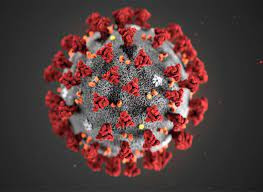
When I was looking at the final prompt and what I should do. I decided to go with Option 1 and to discuss my relationship with technology. If anything has changed technology and the way that we see it, it's TikTok.  TikTok is the leading destination for short-form mobile video. Their mission is to inspire creativity and bring joy. TikTok emerged during a time where the world was in a pretty bad place. With the rising toll of Coronavirus cases and deaths, quarantine became inevitable. People stopped going out, stores closed, the days just consisted of watching the news to find out what was happening with the virus.

I know for me, I'll never forget 2020. I was supposed to graduate high school but in March of that year we were all sent home. I'll never forget hearing the freshman cheer and yell that school was letting out. I remember all of the seniors including myself saying, "We'll be back next week." only for us to never return. I never got to walk the stage or say goodbye to my classmates, it all just ended abruptly. However, right before the summer there was an app, TikTok. I was actually pretty skeptical of this app initially, I did not want to download it. Looking back it makes me think of Diffusion of Innovations and the success that it had. Diffusion of innovations justifies what causes cascades of video content to spread through entire clusters of nodes, or friend groups, because people with close links tend to start following and liking the same TikTok trends.

While TikTok has changed the way that we look at technology, it does not come with some clear negatives. How exposed are we when it comes to TikTok? How exposed is too exposed? What if I told you that the TikTok algorithm looks to read your mind. Looking back in class we discussed privacy as well as artificial intelligence and the way that social media apps are trying to guess what we are going to do now and in the future to predict our behavior. 

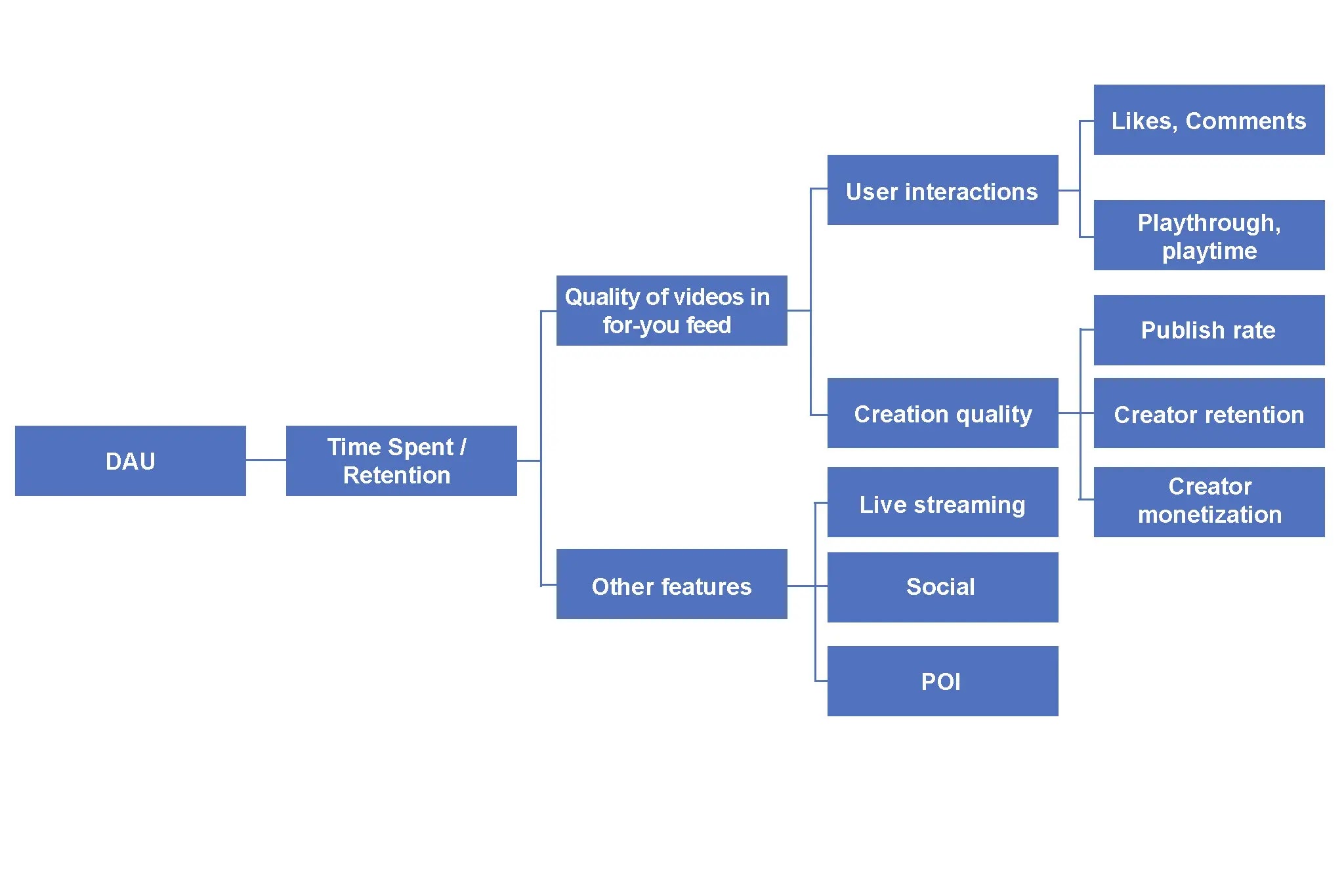
There are four main goals for TikTok’s algorithm: 用户价值, 用户价值 (长期), 作者价值, and 平台价值, which the company translates as “user value,” “long-term user value,” “creator value,” and “platform value.” TikTok takes into account what videos you like, the ones that you skip, if you watch a video all the way through. This is all fair game so that the app can continue to be one of the most successful apps in the world. It succeeded where other short videos apps failed in part because it makes creation so easy, giving users background music to dance to or memes to enact, rather than forcing them to fill dead air. There was actually a Wall Street Journal study that showed, TikTok actually pushes a lot of "sad" content and the impact that could have on younger generations is extremely alarming. This could lead young users down dark rabbit holes that expose them to self harm, addiction, or even suicide. 
It was even said in this document, To analysts who believe algorithmic recommendations pose a social threat, the TikTok document confirms their suspicions. The TikTok algorithm tries to get people addicted to the app. "Each video a kid watches, TikTok gains a piece of information on him. In a few hours, the algorithm can detect his musical tastes, his physical attraction, if he’s depressed, if he might be into drugs, and many other sensitive information. There’s a high risk that some of this information will be used against him. It could potentially be used to micro-target him or make him more addicted to the platform.”


The Truth About TikTok

I watched a sixty minute documentary where it discussed the two versions of TikTok and the effect that has on children in the United States versus the effect it has on children in China. TikTok continues to revolutionize the way that we see technology but at what cost. Growing up we hear that children are sponges and absorb all that they can to learn the ways of the world and how they can fit in. It is alarming to know the truth about TikTok and the demographic that it caters to. I think we need to be extremely conscious of our privacy and the way that apps like TikTok play such a pivotal role in our lives. If an app has come out and said that they are watching you, what level are they not willing to reach to get as close to the everyday consumer as possible? 


Friday, December 9, 2022

EOTO Reaction- Blog Post #11

One of the presentations that caught my eye was the Overton Window. The Overton window is the theory that current news topics are being covered as they are acceptable, popular, and demanding toward the audiences. However, what makes it into the Overton Window and why? Sometimes you will see multiple mainstream news covering the same topic over and over again. However, sometimes they have different agendas, whether they are for or against the topic. The image to the right contains and image that I saw when the presenter went over the Overton Window. There are things that are considered to be popular, policy or sensible that get news coverage. 

News reporters and politicians must be very aware of issues that are impacting the public if they want their issues to be covered in the Overton Window. One could argue that it keeps people accountable to address real world issues that may be happening in our society. 

Something that really stuck with me was when the presenter talked about coronavirus and what that would have looked like in the Overton Window. For months all we heard about was this deadly disease that then turned into a pandemic, there were constant briefings and multiple stories that were coming out about Coronavirus. I remember that it got to a point where you could turn on any mainstream news coverage and in the bottom right there would be a number of those who had been infected, as well as though that had ultimately died from this disease. Prior to this mask wearing and social distancing would have simply been unheard before January 2020. This news would have never made it into the Overton Window.

Overall the presenter did a really nice job on how the Overton Window is constantly changing and adapting to keep up with our ever changing lives. Even though most people do not even know that the Overton Window exists, it would go on to influence our news for decades and even generations to comes. 

EOTO 2- Blog Post #10

What if I told you that Internet Service Providers could block the kinds of content that you see? Net neutrality is the concept that all data traffic on a network should be treated indiscriminately, and internet service providers (ISPs) would be restricted from blocking, slowing down or speeding up the delivery of online content at their discretion. In layman's terms, this stops Internet Service Providers like Comcast and Verizon from blocking your access to services like Netflix or Youtube TV, in order to encourage you to buy a different streaming service. 

Net Neutrality argues "Free Expression" as we have learned in this class through the First Amendment, "everyone has the freedom to hold opinions, receive and voice their ideas without interference by public authority."  If Broadband providers are able to pick favorites online, newer companies can never even get their feet off the ground. Tim Wu coined the term "net neutrality" to call out broadband providers and ask for anti-discrimination rules. Think of a highway. On this highway, there are multiple lanes, you have your traditional lanes that are free and then you have fast lanes. The fast lanes usually through Waze or Google Maps tell you that you will reach your destination earlier because the fast lanes are quicker. However, there is one stipulation to this, it requires money. Whether it be a toll you have to pay or you use your E-ZPass it is not free. This is exactly what Internet Service Providers do when they do not follow net neutrality. In fact Comcast landed in hot water when they banned a home internet user from accessing (VPNs) and the same thing happened with AT&T who banned some of its users from using their WIFI routers. 


What could the future of Net Neutrality look like? It could be a future full of uncertainty. In 2018 the Federal Communications Commission made the "Restoring Internet Freedom Order." This order meant that internet service providers had to disclose information about their network management, practices, and commercial terms of service. They argued that transparency was key when it comes to protecting the openness of the internet. However, just because they are more transparent, does that necessarily make it right? In fact this rule change places primary jurisdiction over Internet Service providers and not with the states. Which is why Attorney generals from more than twenty states, non profits and internet groups filed suit against the Federal Communications Commission. Sixteen states have introduced net neutrality legislation in the 2021 legislative session.

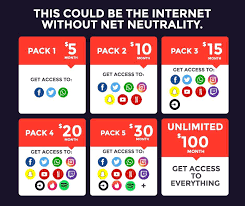
These packages to the right, is what the Internet would ultimately begin to look like if there was no net neutrality. This would benefit those who could afford it. However, the average family especially with inflation being so high would not be able to afford the higher ended packages. Due to the fact that the talk of net neutrality is constantly debated, packages like this in the next year are said to not occur. However, You can expect to see more of the practices that carriers already employ, like letting their own content bypass data limits. An example of this is AT&T currently lets you watch its DirecTV now video service without having it count against your data plan but watching something like Netflix will still chew through your limit.

Sunday, December 4, 2022

"Living in the Age of AI"- Blog Post #9

Artificial intelligence seems pretty revolutionary. We used to watch movies that would try and predict what the twenty first century was going to be like, flying cars, robots that could help us out. All of this sounds cool right? Until you realize that Artificial Intelligence could become one of our worst nightmares we've ever invented. In 2016, in Souel, South Korea one of the first forms of AI was being put to the test. Google was behind a machine that would look to play against a human in a board game. This computer was able to teach itself through other board games and had the ability to create moves no human brain could even begin to fathom. 

Ultimately, the computer ended up outsmarting the human. However, this was just the beginning of what would come from this. Artificial Intelligence has the ability to be able to predict outcomes. In doing so it deepens inequality, challenges our Democracy and most importantly, changes the world. Hypothetically, if you were to give an application on your phone access to another application. The first party voluntarily gives all power to what the third party can do with your information. This is crazy to think about. When you sign up for applications like Twitter, you are agreeing whether you know or not to have some of your information used by third parties. The scary part to this is that you have no idea what these third party apps could be using your information for. 

The video also discussed the implications that Artificial intelligence could have on our democracy such as surveillance capitalism. A lot of experiences want to know what we are doing now, in the past, and in the future. Everything about your thoughts, desires, friends and family. Anything that can be used to predict potential future decisions. This could become a National Security concern, if we are a country that prides itself on the freedom of everyone. What would it look like if the world knew we were watching every little minute detail of every person we could?

For companies like Facebook and Google it is not what you post or what you post, it's about everything. From the shirt you where to if your hair is curly or straight. There are cookies within our phones and laptops collecting data on us. Micro based targeting to learn intimate details about users. This is then used as "Power", potentially by political parties to gain information specifically when it comes to voter behavior and patterns.Think of the cameras that watch you. The airport when you scan your passport can automatically detect your face just off of facial recognition. What are the bias' that come with Artificial Intelligence? There is so much to be discovered about this technology and that is the scary part.. 

The Intoxicating Watch- Would you like "Another Round" ?

Q News Bri Davis Going through a mid-life crisis, not sure what to do? Find a hobby, surround yourself with friends or see a therapist.  Don...